






The main thing I am watching right now is Bitcoin strength, large-cap liquidity, and whether regulation gives the market more confidence. I would still start with Bitcoin and Ethereum, then look at Solana, BNB, XRP, and stablecoins only after I understand the risk.
Current Crypto Data I Am Using
| Coin | Current Price / Data | Recent Change | |
|---|---|---|---|
| Bitcoin | About $80,613 | Up about 1.7% from previous close | |
| Ethereum | About $2,258 | Up about 0.19% from previous close | |
| Solana | About $91.07 | Up about 0.43% from previous close | |
| BNB | About $686.29 | Up about 2.31% from previous close | |
| XRP | About $1.49 | Up about 3.65% in CoinMarketCap dashboard data | |
| USDC | About $0.9997 | Around flat, slightly down | |
| USDT | About $0.9998 to $1.00 | Around flat |
My Simple Rule Before Buying Crypto
I start with the strongest coins first because beginners need survival more than excitement. In crypto, the coin that looks the most exciting is often the one that already moved too far.
I look at price, market cap, trading volume, use case, and risk. Price alone does not tell me enough. A coin can trade under $1 and still be expensive if the supply is huge. Another coin can trade at $80,000 and still be stronger because the demand, liquidity, and market trust are much deeper.
Right now, the broader crypto market is still heavily influenced by Bitcoin. CoinGecko shows the total crypto market cap around $2.63 trillion, with Bitcoin representing about 58.1% of the market and stablecoins about 12.0%. That tells me this is still a Bitcoin-led market, not a full altcoin season.
So my rule is simple: I start with Bitcoin, then Ethereum, then I look at stronger altcoins only if I accept the extra risk.
1. Bitcoin Is Still My First Pick for Most Beginners
Bitcoin is my first pick because it is still the market leader, and the current data supports that view. It is trading around $80,613, with an intraday high near $81,974 and an intraday low near $79,222. That range shows normal crypto volatility, yet Bitcoin is still holding near the important $80,000 area.
I am basing my Bitcoin view on three things: dominance, liquidity, and institutional interest. CoinGecko shows Bitcoin dominance near 58.1%, which means Bitcoin still controls the largest part of the crypto market. MarketWatch also reported that Bitcoin rose as traders watched the Clarity Act, with Bitcoin around $81,473 during that move.
For beginners, Bitcoin is the cleanest crypto story. It has a fixed supply of 21 million coins, the strongest brand, and the most attention from large investors. I would still expect big price swings, but I would rather learn crypto through Bitcoin than through a random small coin.
My view: Bitcoin is the core holding, not the fast gamble.
2. Ethereum Is My Second Pick for Real Crypto Utility
Ethereum is my second pick because it gives exposure to real blockchain activity, not only price speculation. It is trading around $2,258, with an intraday high near $2,317 and an intraday low near $2,241. The daily move is small compared with some altcoins, which makes sense because Ethereum is already a large asset.
I am basing my Ethereum view on utility. Ethereum is used for smart contracts, DeFi, NFTs, token launches, and many crypto apps. Investopedia’s updated crypto overview also lists Ethereum as a major crypto because it enables smart contracts and decentralized applications.
Ethereum still has competition. Solana, BNB Chain, and other networks want the same users and developers. Still, Ethereum remains one of the main names I would study before buying smaller coins.
My view: Ethereum is the best large-cap choice for people who want exposure to crypto apps and blockchain infrastructure.
3. Solana Is the Growth Pick, with Higher Risk
Solana is the coin I would treat as a higher-risk growth pick. It is trading around $91.07, with an intraday range between $90.48 and $93.63. That tells me Solana is active, but still much more sensitive to market mood than Bitcoin.
I am basing my Solana view on network activity and trading use. CoinGecko’s Q1 2026 crypto report said Solana remained the top chain for spot trading volume on decentralized exchanges in Q1 2026, with 30.6% quarterly dominance, even though its trading volume dropped 26.5%.
That is useful information. It tells me Solana is still being used, especially by active traders. At the same time, the drop in volume reminds me that Solana can cool down quickly when the market slows.
My view: Solana has strong upside potential, but I would size it smaller than Bitcoin or Ethereum.
4. BNB Is an Ecosystem Bet
BNB is useful, but I would treat it as an ecosystem bet connected to Binance and BNB Chain. It is trading around $686.29, with an intraday high near $689.54 and an intraday low near $670.67. Its current move is stronger than Bitcoin and Ethereum in this snapshot, up about 2.31% from the previous close.
I am basing my BNB view on utility and ecosystem strength. CoinMarketCap’s BNB update said BNB overtook XRP in market cap in April 2026, helped by a quarterly burn that removed 1.72 million BNB, worth about $1.28 billion, from circulation. It also mentioned BNB Chain reporting 15 million daily transactions in Q1 2026.
That sounds strong, but I would still be careful. BNB is not only about blockchain use. It is also tied to exchange trust, regulation, and the Binance ecosystem.
My view: BNB can make sense for ecosystem exposure, but I would not treat it as neutral or low-risk.
5. XRP Is a Payments and Regulation Story
XRP is more speculative for me because its price often reacts to regulation, payments news, and investor sentiment. CoinMarketCap’s market overview shows XRP around $1.49, up about 3.65% in its dashboard data. CoinGecko also shows XRP as a major large-cap coin, with market cap around the mid-$80 billion range in its XRP market data.
I am basing my XRP view on its payment use case and market position. XRP has been around for years, and many people follow it because of its connection to cross-border payments and regulatory developments. That gives it attention, but also makes it news-sensitive.
For beginners, I would not put XRP in the same category as Bitcoin. Bitcoin has the clearest long-term investment story. XRP needs more belief in its payment role and regulatory path.
My view: XRP is worth watching, but I would keep the position controlled because the risk is high.
7. Stablecoins Are for Cash Management, Not Growth
Stablecoins like USDC and USDT are tools I would use for holding cash inside crypto, not for price growth. USDC is trading close to $0.9997, with CoinMarketCap showing a live market cap around $76.6 billion and about 76.6 billion USDC in circulating supply. USDT is the larger stablecoin, with CoinMarketCap historical data from May 3, 2026 showing USDT near $0.9998 and market cap around $189.5 billion.
I am basing my stablecoin view on market size and use. CoinGecko shows the stablecoin category around $317 billion in market cap, which means stablecoins are a huge part of crypto liquidity. Reuters also reported that Circle’s USDC circulation grew 28% year over year to $77 billion, showing that stablecoin demand stayed strong during volatile markets.
Still, stablecoins are not risk-free. They depend on reserves, issuers, regulation, and exchange liquidity. I would use them for flexibility, not as a replacement for a bank account.
8. My Final Beginner-Friendly Watchlist for May 2026
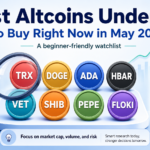
My watchlist stays simple: Bitcoin first, Ethereum second, Solana for growth, BNB and XRP for specific stories, and stablecoins for cash management.
Here is how I would think about it:
- Bitcoin because it leads the market and has the strongest beginner-friendly investment case.
- Ethereum because it gives exposure to smart contracts and crypto apps.
- Solana because it has strong activity and growth potential, with higher risk.
- BNB because it is useful inside a major crypto ecosystem, with platform and regulatory risk.
- XRP because it has a payments story and large community, with higher news-driven risk.
- USDC or USDT because they help manage cash inside crypto, not because they are meant to rise in price.
I would not buy every coin just to feel diversified. I would rather understand three coins well than hold ten coins for no clear reason. For beginners, that usually means starting with Bitcoin and Ethereum, then adding risk only when the reason is clear.