





Best Altcoins Under $1 to Buy Right Now in May 2026
I like looking at altcoins under $1 because they are easy for beginners to understand at first glance. A person can buy 100, 1,000, or even 100,000 tokens without needing a large starting budget. That feels exciting.
However, I never judge a coin only by its price.
A coin priced at $0.01 can still be expensive if the supply is massive. A coin priced at $0.40 can be stronger if it has real liquidity, a large user base, and strong exchange support. That is why I look at market cap, trading volume, supply, community, and real use before I think about buying.
For May 2026, I would stay selective. CoinGecko reported that the total crypto market cap fell 20.4% in Q1 2026, ending March near $2.4 trillion. Centralized exchange spot trading volume also dropped 39.1% in Q1 to $2.7 trillion, which tells me traders became more cautious after the market cooled down.
CoinMarketCap’s May 3, 2026 historical snapshot showed total crypto market cap around $2.62 trillion, 24-hour volume around $92.56 billion, Bitcoin dominance at 60.4%, Ethereum dominance at 10.8%, and the Fear & Greed score at 46 out of 100. I read that as a mixed market, not full panic, not full greed.
May 2026 Crypto Market Snapshot
The market in May 2026 feels cautious to me. I would not call it a clean altcoin season because Bitcoin still controls a large share of the total market. CoinMarketCap explains Bitcoin dominance as Bitcoin’s market cap compared with the total crypto market cap, and traders watch it to understand whether money is mainly staying in Bitcoin or moving into altcoins.
That matters for under-$1 altcoins.
When Bitcoin dominance is high, many altcoins struggle to outperform. New buyers may prefer Bitcoin because it feels safer than smaller tokens. When Bitcoin dominance starts falling, altcoins often get more attention because traders rotate into higher-risk assets.
On May 3, 2026, Bitcoin dominance was 60.4%, which is high enough for me to stay careful. The Fear & Greed Index was 46/100, which suggests a neutral to cautious market mood rather than strong euphoria.
There was also real weakness earlier in 2026. Reuters reported in February 2026 that Bitcoin fell to about $63,525, its lowest level since October 2024, and that the broader crypto market had lost around $2 trillion in value since its October peak.
So, my view is simple: May 2026 is a time for watchlists, careful entries, and smaller positions. I would not treat every cheap altcoin like a guaranteed opportunity.
How I Choose Cheap Altcoins Without Getting Trapped
I use a basic filter before I even think about buying an under-$1 coin.
First, I check market cap. This tells me how large the project already is. If a coin already has a huge market cap, I do not expect it to multiply easily just because the price is under $1.
Next, I check trading volume. I want to see whether people are actually buying and selling the coin. Low volume can make it harder to enter or exit without a bad price.
Then I check supply. This is one of the most important points for beginners. A massive supply can make a $1 target unrealistic. I do not want to buy a token only because social media says it can “go to one dollar.”
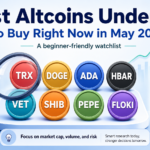
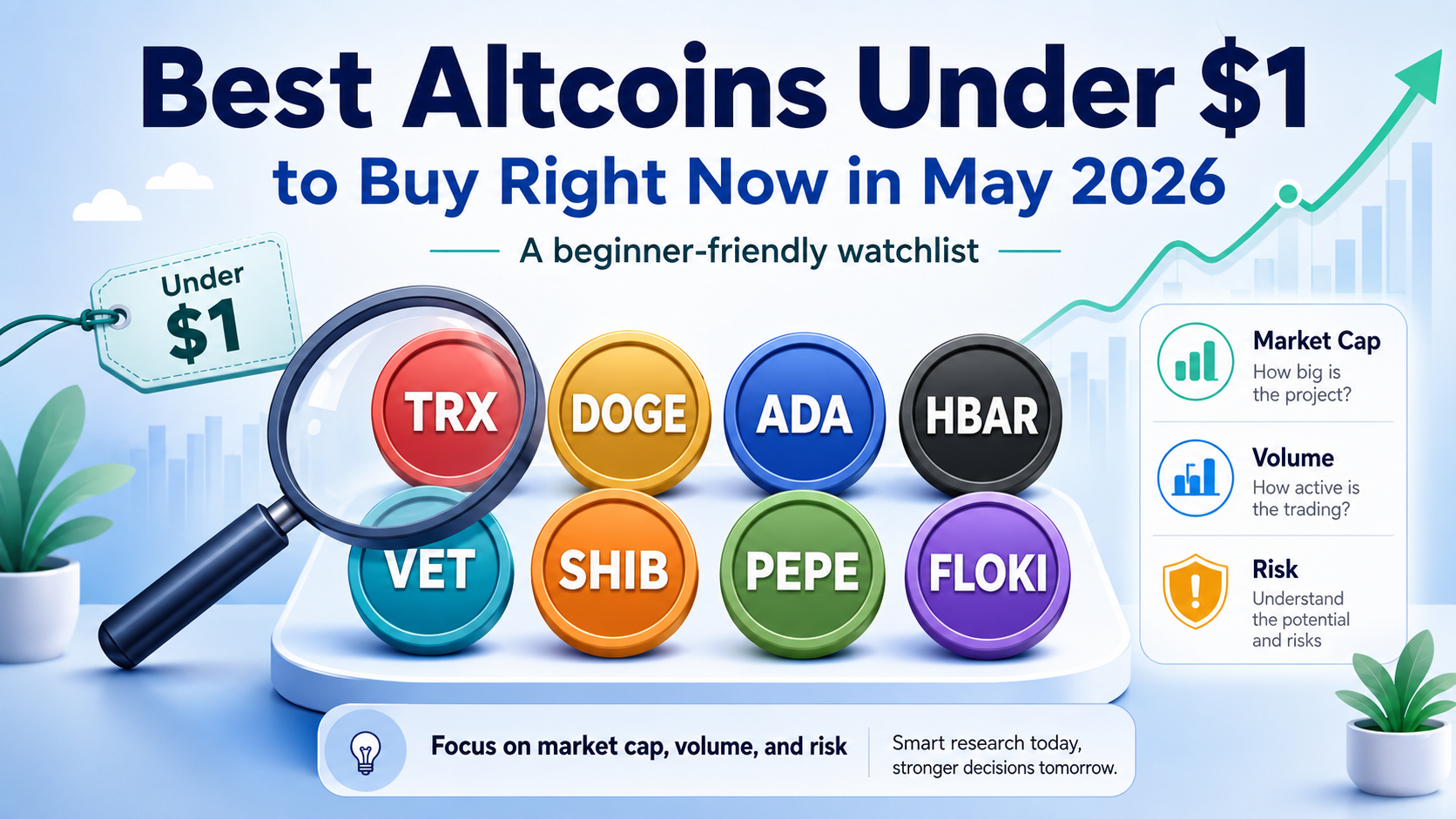
After that, I check the use case. I ask myself a simple question: why should this coin exist? TRX has payment and stablecoin activity. ADA has smart contracts. HBAR focuses on enterprise use. VET focuses on supply chain tracking. Meme coins like DOGE, SHIB, PEPE, and FLOKI rely more on attention, culture, and community.
Finally, I check whether the coin is easy to trade on major exchanges. Strong listings can help liquidity. Weak listings can make the coin riskier, especially during market drops.
Best Under-$1 Altcoins to Watch in May 2026
Here is how I would organize the main names for a beginner-friendly watchlist.
| Altcoin | Category | Why I Would Watch It | Main Risk |
|---|---|---|---|
| TRON (TRX) | Layer 1 and payments | Large market cap, strong liquidity, stablecoin activity | Centralization and regulatory concerns |
| Dogecoin (DOGE) | Meme coin and payments | Huge brand awareness and deep liquidity | Price depends heavily on sentiment |
| Cardano (ADA) | Smart contract Layer 1 | Known ecosystem and long-term community | Strong competition from other chains |
| Hedera (HBAR) | Enterprise blockchain | Business-focused network and different technology model | Enterprise adoption can move slowly |
| VeChain (VET) | Supply chain blockchain | Clear real-world tracking narrative | Needs stronger demand and market attention |
| Shiba Inu (SHIB) | Meme ecosystem | Large community and ecosystem attempts | Huge supply and speculation risk |
| Pepe (PEPE) | Meme coin | Strong retail attention during meme cycles | Limited fundamental support |
| Floki (FLOKI) | Meme plus ecosystem | Community, branding, and product attempts | High volatility and narrative risk |
I would not put all of these coins in the same risk bucket. TRX and ADA feel more established. DOGE is a large meme coin with real liquidity. HBAR and VET are more utility-focused. SHIB, PEPE, and FLOKI are much more speculative.
Best Safer Picks: Larger Under-$1 Altcoins
For the safer side of the under-$1 list, I would focus on coins with larger market caps, stronger liquidity, and longer histories. That does not make them safe in the normal investing sense. Crypto is still volatile. Still, these names usually have more market depth than random small-cap tokens.
TRON (TRX) is one of my first picks in this category. CoinMarketCap showed TRON with a market cap around $33.32 billion, 24-hour volume around $760.32 million, total supply around 94.79 billion TRX, and circulating supply around the same level. Those numbers tell me TRX is liquid and widely traded.
I also like that TRON has a clear payment and stablecoin connection in the market. CoinMarketCap’s TRON update page noted that TRON powered a large stablecoin card spending surge in early May 2026, which supports the idea that the network is still relevant in payments and stablecoin movement.
Dogecoin (DOGE) is also a safer meme coin compared with smaller meme tokens because it has deep liquidity and broad recognition. Investopedia’s updated May 2026 crypto overview describes Dogecoin as the original memecoin, created as satire but still widely used and widely known.
Cardano (ADA) belongs in this group because it has been around for years and remains one of the better-known smart contract networks. Investopedia describes Cardano as a research-driven proof-of-stake network that competes with Ethereum.
For beginners, I would explain this group like this: these coins may not be the fastest movers, yet they are easier to research, easier to trade, and less likely to disappear overnight than tiny unknown tokens.
Best High-Risk Picks: Meme Coins Under $1
Meme coins can be fun, and I understand why many new crypto buyers like them. They are simple to talk about, they move fast, and they can create huge online communities. Still, I treat them as the risky side of the portfolio.
SHIB is popular because of its community and very low token price. The danger is supply. CoinMarketCap’s all-crypto page showed Shiba Inu with supply above 589 trillion SHIB, which explains why beginners should be careful with “SHIB to $1” claims. A move like that would require an enormous market cap.
PEPE is more of a pure meme momentum trade. I would only watch it when meme coin volume is heating up. I would not buy it because of long-term fundamentals.
FLOKI has tried to build more around its brand, which makes it more interesting than some meme tokens. Still, it remains highly volatile. When the market becomes risk-off, meme coins can fall harder than larger crypto assets.
My rule for meme coins is simple: I only use money I can afford to lose. I also avoid buying after a huge green candle because meme coin tops can form quickly.
Key Numbers I Check Before Buying
Before buying any under-$1 altcoin, I check the numbers in this order:
- Market cap
- 24-hour trading volume
- Circulating supply
- Total supply or max supply
- Fully diluted valuation
- Exchange listings
- Price history
- Bitcoin dominance
- Fear & Greed score
- Recent news or development activity
Market cap tells me how much the market already values the coin. Trading volume tells me whether there is enough activity. Supply tells me whether the price target people talk about online makes sense.
I also look at Bitcoin dominance because it tells me whether altcoins are getting attention. CoinMarketCap’s May 3, 2026 data showed Bitcoin dominance at 60.4%, which makes me more careful with smaller altcoins.
The Fear & Greed Index helps me understand mood. CoinMarketCap says the index uses signals like volatility, momentum, volume, dominance, and social data to measure market sentiment on a 0 to 100 scale.
I do not use these numbers as magic signals. I use them to avoid emotional buying.
Risks of Buying Altcoins Under $1
The biggest risk is misunderstanding price.
A beginner may think a coin at $0.01 is cheaper than a coin at $0.50. That can be wrong. The coin at $0.01 may already have a larger market cap because the supply is huge.
Another risk is low liquidity. If a coin has weak volume, the price can move sharply against you. Exiting can become difficult during a sell-off.
There is also token unlock risk. Some projects release more tokens over time. More supply can put pressure on price if demand does not grow.
Meme risk is another big one. Meme coins can explode during hype cycles, then drop fast when attention moves elsewhere. That does not mean all meme coins are bad. It means timing and position size matter.
Finally, regulation and exchange risk can hurt altcoins quickly. If an exchange delists a token or regulators target a project, price and liquidity can suffer.
Simple Buying Strategy for Beginners
My beginner strategy is boring, and that is the point.
I do not put all my money into one under-$1 coin. I split my watchlist into categories. For example, I might place established coins like TRX, DOGE, ADA, and HBAR in one group, utility coins like VET in another group, and meme coins like SHIB, PEPE, and FLOKI in the highest-risk group.
Then I decide how much risk I want.
A beginner might keep most of the crypto budget in larger assets and use only a small part for under-$1 altcoins. That helps reduce emotional decisions. I also prefer buying in smaller amounts instead of going all in at once, especially when the market is still uncertain.
I also write down my reason before buying. If I cannot explain why I want the coin in one or two clear sentences, I usually skip it.
For example:
“I am watching TRX because it has strong liquidity and payment activity.”
“I am watching ADA because it is an established smart contract network.”
“I am watching PEPE only as a meme momentum trade.”
That small habit helps me avoid random buying.
Final Verdict: Which Under-$1 Altcoins Look Most Worth Watching?
For May 2026, my main under-$1 watchlist starts with TRX, DOGE, ADA, HBAR, and VET. These have clearer histories or use cases than most tiny tokens. I would put SHIB, PEPE, and FLOKI in the speculative group because they can move fast, yet the risk is much higher.
If I had to simplify the whole article for a beginner, I would say this:
TRX looks like one of the strongest under-$1 coins by market size and liquidity. DOGE remains the most famous meme coin. ADA is a known smart contract platform. HBAR and VET are more utility-focused. SHIB, PEPE, and FLOKI are mainly for high-risk meme exposure.
I would not buy any of them only because they trade below $1. I want volume, market cap, supply, use case, and timing to make sense. In May 2026, Bitcoin dominance is still high and the broader market is still recovering from a weak first quarter, so I would rather be selective than chase every cheap coin on social media.